VB / C# FFT IMPlementation: Fast Fourier Transforms in .NET
How FFT (Fast Fourier Transformation) works
A Fourier transformation converts a signal (samples, measures) from its original representation in the time or space domain into a representation in the frequency domain and vice versa. Both representations carry the same information about the source signal. However, the frequency domain allows a very different perspective to your data, delivers valuable insights and allows for efficient manipulation of your data in many technical areas.Basically, the frequency domain as the result of the FFT allows one to look at the data as being assembled out of a number of sine and cosine wave signals. The frequencies of the sinusoidals are determined by the sampling frequency of the original data and the number of samples in the signal. The frequency bins delivered by the DFT provide information about the intensities (magnitudes) of these individual frequencies needed in order to sum up to the original signal.
The FFT rapidly computes such transformations by an efficient factorization algorithm. As a result the computational complexity of the transformation is dramatically reduced and the results are delivered much faster.
ILNumerics: C# FFT Example
ILNumerics implements the fastest algorithm available today and - together with the efficiency of the Computing Engine - brings the best possible speed for large data on multicore processors.
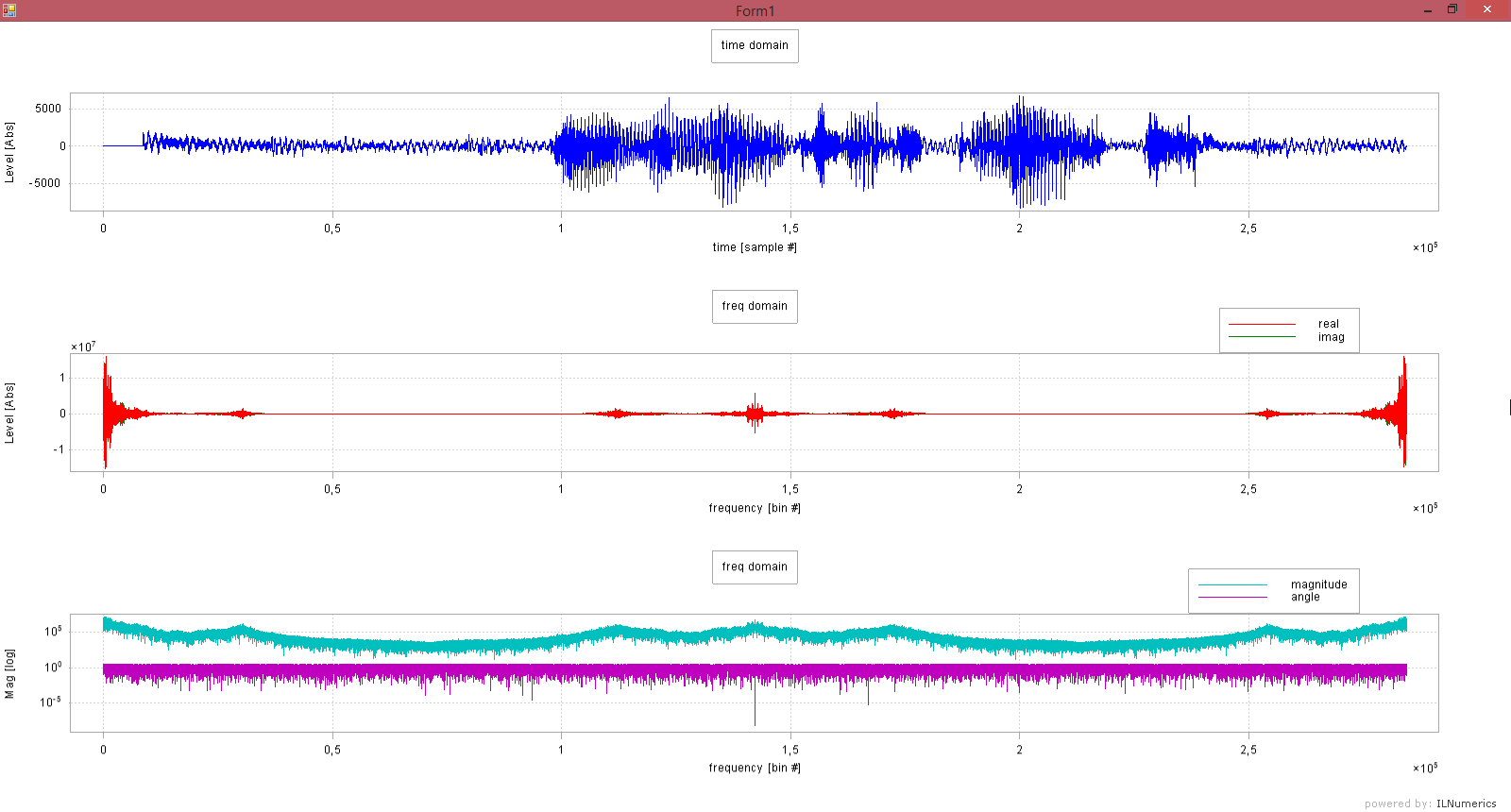
Example: A speech signal and its fourier transform. Download the complete C# FFT example from the examples section.
FFT in C# / Visual Basic: Interfaces in .NET
ILNumerics provides interfaces to forward and backward fast fourier transformations (FFT), for real and complex floating point data, in single and double precision, in 1...n dimensions. The .NET interface (available for C# and Visual Basic) is similar to the one known from popular mathematical languages like Matlab®. FFT can be computed for any size and dimension number. Signal lengths of 2n, where $n \in N$ are computed most efficiently.
The recommended way for fourier transforms is to utilize the static functions from the
ILNumerics brings an efficient purely-managed FFT implementation by default. An even faster, optimized version relies on the Intel MKL® for FFT computations and is enabled by adding the nuget package ILNumerics.Core.Native to your project. Details and configuration options are found in the FFT Modules article.