ILNumerics Autonomous Computing
ILNumerics Autonomous Computing reduces the economic cost of high-performance technical software. It turns readable ONAL-style .NET array code into autonomous, dependency-safe, massively parallel execution — without making manual threading, GPU programming, or low-level runtime engineering the center of development.
Technical software teams face a growing productivity gap: modern hardware is massively parallel, but most numerical algorithms are still written, reviewed, optimized, and maintained as sequential high-level code. ILNumerics closes this gap by moving optimization, parallelization, and hardware utilization into the execution layer.
Less manual performance engineering. More usable parallel hardware.
The economic problem
Performance optimization is expensive. It often requires expert developers, manual parallelization, hardware-specific rewrites, native kernels, GPU programming, benchmarking, and separate optimized code paths. Each step adds development time, project risk, and long-term maintenance cost.
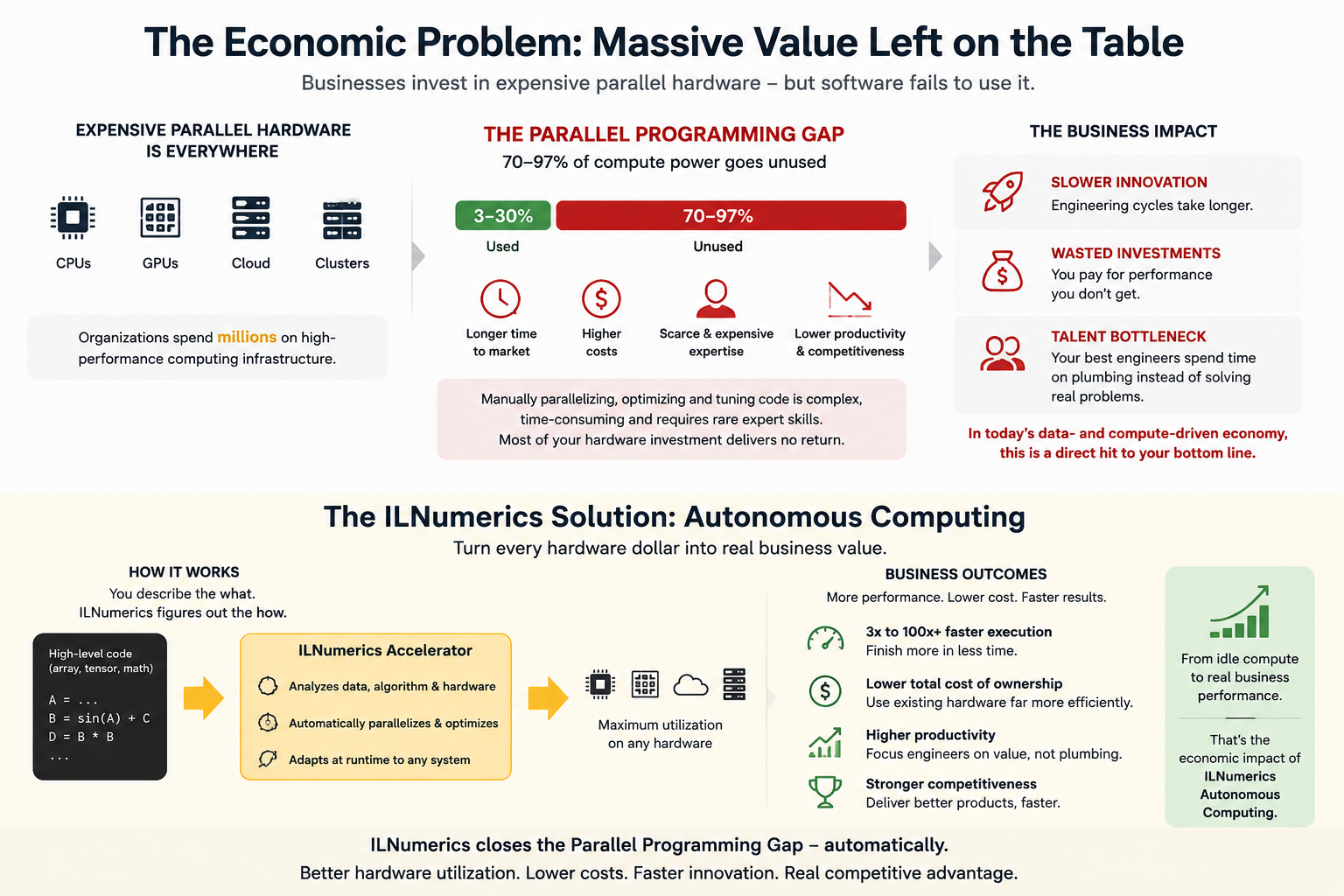 This creates a bottleneck for engineering, scientific, industrial, simulation, and analytical software. Valuable numerical IP may exist in readable high-level code, but turning it into fast, scalable, production-ready software still depends on scarce optimization expertise.
The result is an economic mismatch: companies buy parallel hardware, but much of that performance remains difficult to use because exploiting it manually is too expensive, too fragile, or too specialized for everyday technical software development.
The ILNumerics approach
ILNumerics changes the execution model. Instead of asking developers to manually identify, rewrite, and maintain parallel regions, ILNumerics gives array instructions autonomous execution freedom and constrains that freedom only by the local data dependencies required for correctness.
The main thread activates work and captures the minimal dependency structure. Autonomous array instructions then execute their workloads as early as correctness allows, using suitable compute resources at runtime.
The result is high-level numerical code that can execute concurrently, pipelined, and massively parallel — while the source code remains readable, sequential, and close to the mathematical intent of the algorithm.
ILNumerics preserves the dependencies required for correctness and removes the unnecessary sequencing that prevents parallel execution.
Open algorithms, enterprise execution
ILNumerics.ONAL provides the open numerical algorithm language for .NET. It lets developers author, review, test, and maintain numerical algorithms with familiar NumPy- and MATLAB-style array semantics, without locking the algorithmic IP into a closed runtime.
ILNumerics.Computing is the compatible enterprise upgrade path. ONAL-style algorithms can run on ILNumerics.Computing as a 1:1 drop-in replacement, adding automatic acceleration, commercial toolboxes, visualization integration, developer tools, and support for production applications.
This creates a clean adoption path: algorithms can start open, portable, and readable in ONAL, then scale into enterprise-grade, accelerated technical applications when the project requires more performance, tooling, visualization, and support.
What this means for software teams
- Less time spent rewriting algorithms for performance
- Less dependency on rare HPC, threading, or GPU specialists
- Fewer hardware-specific code paths to maintain
- A shorter path from numerical prototype to production application
- More maintainable numerical IP in readable .NET code
- Better use of existing CPU and accelerator hardware
- A clear upgrade path from open ONAL algorithms to ILNumerics.Computing
From optimization project to platform capability
In traditional workflows, performance is often a separate project. A working algorithm is later profiled, rewritten, parallelized, ported, tuned, and maintained by experts. This slows delivery and makes high-performance software difficult to scale across teams.
ILNumerics turns much of this work into a platform capability. Optimization and massively parallel execution are handled below the application logic, so developers can focus on the numerical model, business logic, visualization, and product experience.
This does not make performance irrelevant. It makes performance more accessible. Instead of encoding every execution decision manually, developers express the numerical intent in array code and let the runtime transform that intent into optimized execution.
Why autonomous execution matters
Manual parallelization works well for obvious cases, such as independent loop iterations. But many technical programs do not expose their performance potential as clean parallel loops. Real applications contain data dependencies, function calls, intermediate results, visualization logic, I/O, changing data sizes, and changing hardware conditions.
ILNumerics works below the loop level. It reduces synchronization to local array dependencies and removes unnecessary sequencing from execution. This allows more of the program to overlap in time and makes parallel hardware useful in cases where manual parallelization would be unsafe, impractical, or too expensive to maintain.
This is the central advantage of Autonomous Computing: the program remains readable and maintainable, while execution can become concurrent, pipelined, and massively parallel wherever the dependency structure allows it.
Economic impact
Autonomous Computing can reduce the cost of technical software production by shrinking or eliminating several manual performance-engineering stages: parallelization design, hardware-specific rewrites, low-level kernel tuning, device selection, benchmarking cycles, and maintenance of specialized execution paths.
For companies building engineering, scientific, industrial, simulation, or analytical applications, this means faster delivery, lower technical risk, better hardware utilization, and stronger long-term ownership of numerical IP.
ILNumerics helps turn numerical IP into scalable technical software without turning every project into a performance-engineering project.
Part of the ILNumerics platform
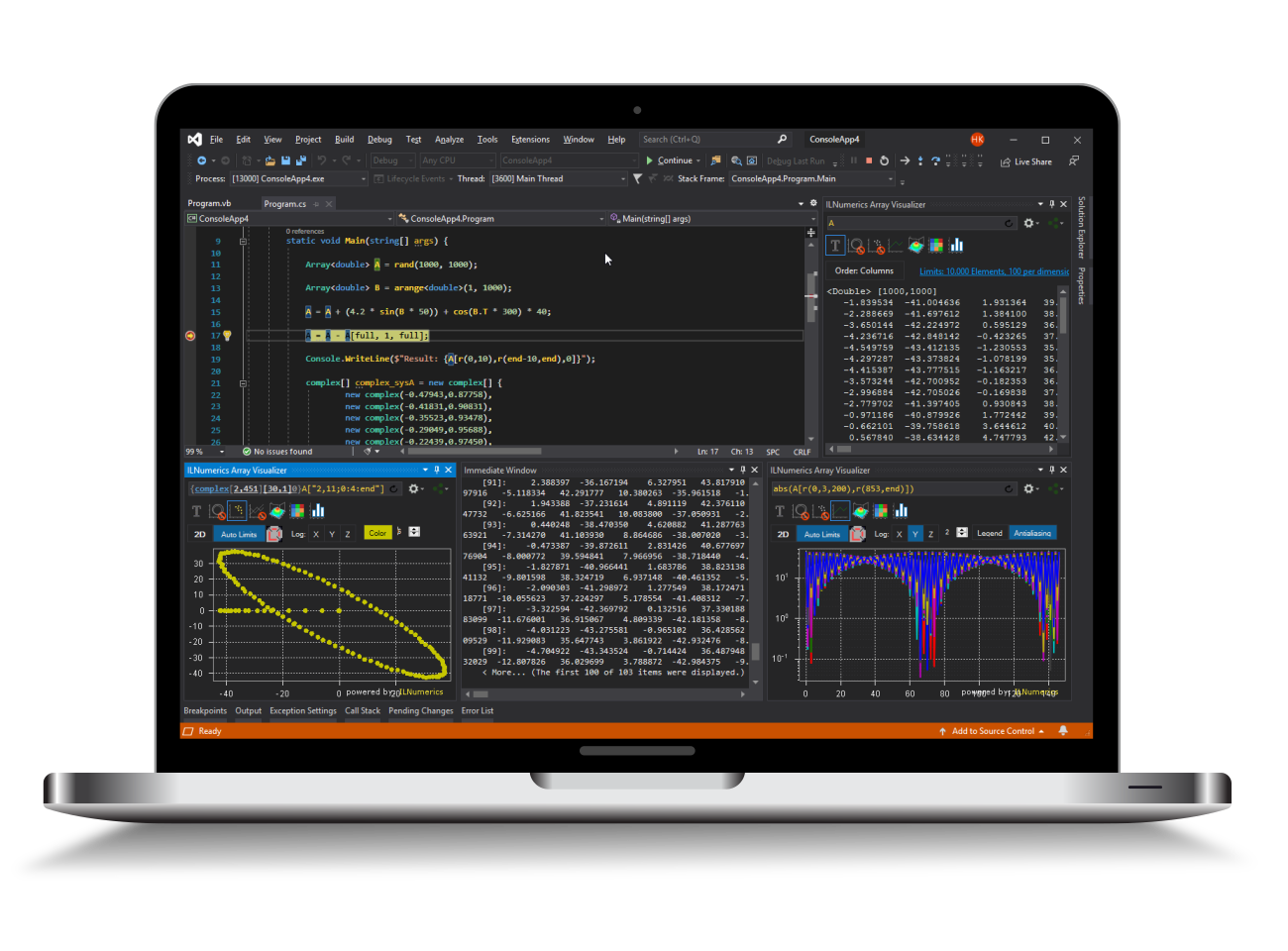
Autonomous Computing is part of the ILNumerics platform for technical .NET applications. It works together with ILNumerics.Computing, commercial numerical toolboxes, managed linear algebra and FFTs, interpolation, optimization, HDF5 integration, interactive 2D/3D visualization, and Visual Studio developer tools.
For a deeper technical explanation of autonomous array instructions, execution nets, array pipelining, micro-JIT optimization, and heterogeneous resource use, read the ILNumerics Accelerator technology page.
TL;DR
ILNumerics Autonomous Computing reduces the economic cost of high-performance technical software. Teams can keep numerical algorithms readable and portable in ONAL-style .NET array code, while ILNumerics.Computing moves optimization, parallelization, and hardware utilization into the runtime.
The result is less manual performance engineering, better use of modern parallel hardware, and a shorter path from numerical IP to production-ready technical applications.