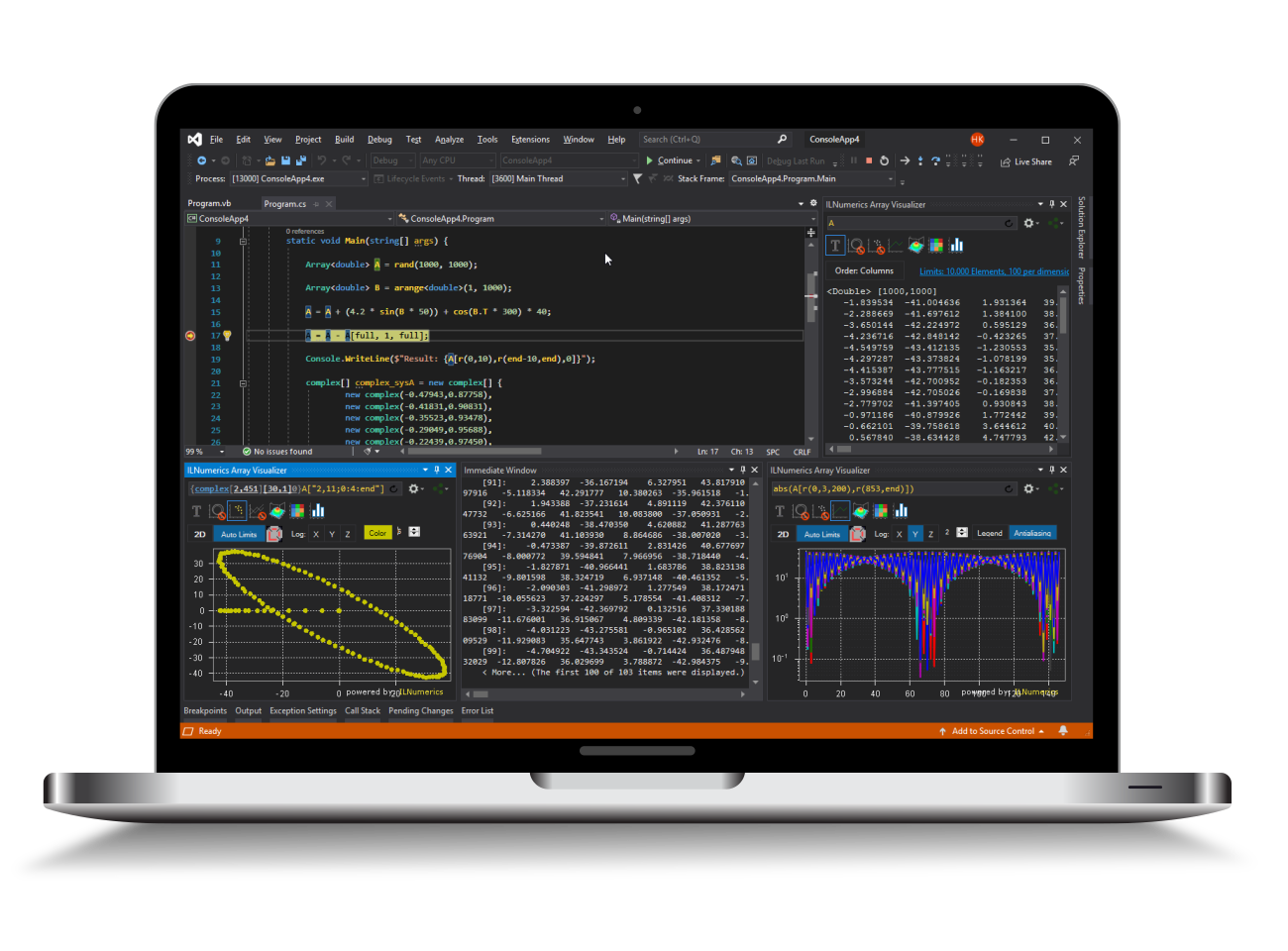
Examples, Benchmarks & Case Studies
Explore ILNumerics in practice: reproducible Accelerator benchmarks, example applications, technical demos, and case studies for numerical, visual, and production-ready .NET software.
This section helps developers and decision makers understand what ILNumerics can do in real projects — from high-performance array code and autonomous parallel execution to interactive 2D/3D visualization and full technical application development.
Accelerator benchmarks
The Accelerator benchmark pages demonstrate how ILNumerics turns high-level .NET array code into autonomous, dependency-safe, massively parallel execution. They include correctness checks, speedup measurements, benchmark explanations, and links to reproducible artifacts.
- Benchmarks overview: start here for the full benchmark collection and reproducible artifacts.
- Speed comparison: ILNumerics, NumPy, Numba and Fortran: compares a low-level array expression across different numerical runtimes.
- Getting Started Part I: simple array expressions: verifies correctness and measures acceleration for a compact numerical expression.
- Getting Started Part II: k-means clustering: shows acceleration in a larger numerical function context.
- Getting Started Part III: faster FFTs: compares large Fast Fourier transform batches with optimized native numerical libraries.
- Getting Started Part IV: array pipelining: explains autonomous array instruction parallelism beyond traditional manual loop parallelization.
Example applications
Example applications show how numerical computing, visualization, and developer tooling work together in complete .NET workflows. Use them as starting points for engineering dashboards, simulation tools, measurement software, analytical applications, and custom visual interfaces.
- Examples Overview: find all examples and locations
- Getting Started with ILNumerics: create a first numerical project, run accelerated array code, and generate a simple 3D plot.
- Getting started with visualization: build your first interactive ILNumerics visualization.
Case studies
Case studies show how ILNumerics is used in technical, scientific, industrial, and analytical software projects. They focus on real-world value: reducing development effort, keeping numerical IP maintainable, integrating visualization into production applications, and using modern hardware more effectively.
- Case studies overview: explore customer and project stories built with ILNumerics.
Reproducible research and technical artifacts
Some benchmark pages are connected to reproducible research artifacts. They make benchmark setup, source code, measurement conditions, and implementation details transparent.
- Reproducible benchmark artifacts on GitHub
- “A Virtual Processor brings back the Free Lunch” on arXiv
- Download the paper as PDF
What to explore first
If you are evaluating ILNumerics for a project, start with the benchmark overview and the Getting Started guide. If your focus is visualization, start with the Visualization Engine examples. If your focus is technical strategy, start with Autonomous Computing and the Computing Engine page.